Файл:Exoplanet Period-Mass Scatter History.gif

Тлумачэнне
| Апісанне |
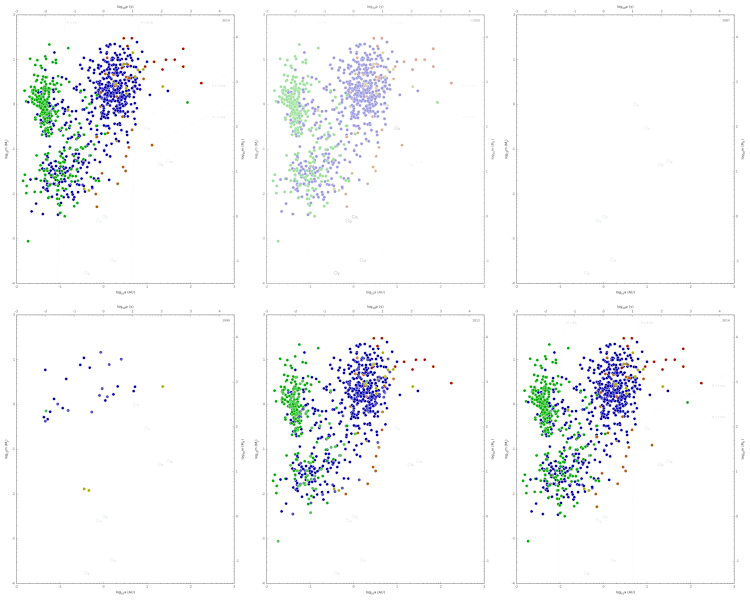
English: Scatter plot of mass, m, and semimajor axis, a, for exoplanet discoveries through 2014-09-23 animated by year, indicating the discovery method using distinct colors:
radial velocity (dark blue)
transit (dark green)
timing (dark purple)
direct imaging (dark red)
microlensing (dark orange)
Solar System planets for reference
Estimates (see "important note" below) of m and a are indicated with circles. Scales indicate (log10 of) mass, m, expressed as Jupiter masses (left) and Earth masses (right); and (log10 of) semimajor axis, a, expressed in AU (bottom), and the corresponding period, p for a planet orbiting a Sun-mass star, expressed in Earth years. Reference lines are provided in the final frame as a rough measure of the difficulty of detecting exoplanets using radial velocity and transits. Dashed lines trace the combinations of m and a values that produce the indicated radial velocity semi-amplitude K for a planet orbiting a solar-mass star (assuming m << M). Dashed lines trace the m (for Jupiter-density) and a values where the geometric probability, P, of transit for a solar-radius star (assuming a circular orbit, so that e and ω can be ignored) is the indicated value (less than the indicated proportion of all planets to the right of a given line will have transiting orbits). Exoplanet data is from the Open Exoplanet Catalogue,[1] version 811d352, including some (mostly from the Kepler mission) whose semi major axes are computed from period data. The figure excludes 4 planets with semimajor axes outside the range of the figure and 1 (PSR B1257+12 b) with a mass lower than the range of the figure. Important note: This figure is intended to serve as a visualization of the catalog of generally accepted candidate exoplanets using the distribution of some of their basic properties related to detection. No attempt has been made to characterize the degree of confidence (which varies widely) in the existence of a given planet or its properties. Nor is any attempt made to convey systematic errors associated with a particular method. In particular, the indicated mass, m, for an exoplanet characterized using radial velocity is the minimum mass (so that the actual distrubiton of masses for non-transiting planets may be shifted and "smeared" significantly upward). Note: Due to limitations with MediaWiki's handling of GIFs, the previews and thumbnails for this file are of very poor quality and are not intended for use in articles. Only the original image should be used, as a resource for downloading and use on other sites.
|
| Дата | |
| Крыніца | Уласная праца, based on a figure by E.A.L. and used with permission |
| Аўтар | Aldaron, a.k.a. Aldaron |
| Іншыя версіі |
Other versions
Graphs for individual methods
Related graphs
|



Ліцэнзіяванне:

|
Я, уладальнік аўтарскіх правоў на гэты твор, перадаю яго ў грамадскі набытак. Дазвол сапраўдны для ўсяго свету. У некаторых краінах гэта не можа быць юрыдычна магчыма; калі так, то: Я дазваляю кожнаму выкарыстоўваць гэтую працу ў любых мэтах, без аніякіх умоў, калі толькі такія ўмовы не патрабуюцца паводле закону. |
Гісторыя файла
Націснуць на даце з часам, каб паказаць файл, якім ён тады быў.
| Дата і час | Драбніца | Памеры | Удзельнік | Тлумачэнне | |
|---|---|---|---|---|---|
| актуальн. | 01:18, 24 верасня 2014 | | 720 × 864 (1,42 MB) | wikimediacommons>Aldaron | Test scaled down GIF |
Выкарыстанне файла
Наступная 1 старонка выкарыстоўвае гэты файл:
